When It Comes to NATO, Do Actions Count More Than Budgets?: the Canada Letter
Written by Ian Austen, 13 July 2018
Adapted by Shawna Birnbaum, 12 July 2019
Source: The New York Times
“His presentation was ‘a classic Trump performance — bluster, confrontation and demands followed by a unilateral declaration of victory.’”
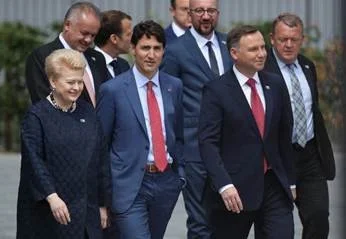
Prime Minister Justin Trudeau was probably relieved that his German and British counterparts were the targets of President Trump’s wrath before and after this week’s NATO summit meeting in Brussels.
In the aftermath of last month’s Group of 7 meeting in Quebec (in which the prime minister was branded “weak” and “dishonest”), the president’s style of diplomacy in Europe provided a mix of bashing the United States’ closest allies, demands, ultimatums and threats — veiled and direct.
Mr. Trump’s biggest complaint about NATO is one that has been echoed by his U.S. predecessors, including Barack Obama and George W. Bush. His presentation was “a classic Trump performance — bluster, confrontation and demands followed by a unilateral declaration of victory.”
Increase to 4%?
The United States has maintained that some NATO members are not paying their fair share of the alliance’s military budget. The Times' Washington Bureau's fact checkers found Trump's claims to be misleading at best.
Canada, et al., Not Meeting NATO GDP Spending Guideline
Many countries do not meet NATO’s guideline to spend the equivalent of 2 percent of their gross domestic product on their military.
Though alliance members have pledged to reach that 2 percent goal by 2024, Mr. Trump increased his demand, saying that the target should be 4 percent.
After the NATO meetings, Mr. Trump said that he pushed the other members into agreeing to quickly meet the 2 percent level, a claim denied by Mr. Trudeau and other leaders.
Canada’s spending is between 1.2 and 1.4 percent, roughly 25 billion Canadian dollars this year. By comparison, about 3.6 percent of G.D.P. goes toward education.
Spending Target Irrelevant
“I have issues with that percentage of G.D.P. approach,” Elinor Sloan, a professor of political science at Carleton University and a former analyst at the Department of National Defense in Ottawa. “It does nothing to measure military contributions and capability.”
Greece, she noted, is a member in good standing of the 2-percent club. But it contributes almost nothing to NATO missions and it has a military with limited capabilities.
Doing vs. Spending
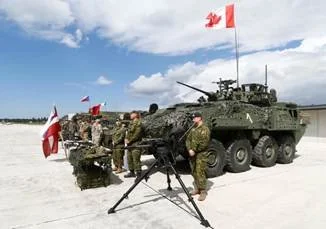
Before the meeting, Mr. Trudeau stopped by Latvia, signaling that doing versus spending for NATO is what counts. He announced that Canada would:
extend its NATO mission in that country by four years.
increase the number of Canadian troops in the Baltic region from 455 to 540 to discourage any Russian incursion.
deploy up to 250 Canadian troops and four military helicopters on a NATO training mission in Iraq this fall.
send 250 additional troops to support a United Nations peacekeeping mission in Mali.
Apple Falls Far from Tree
Professor Sloan said that Trudeau’s government had not followed the mold set by many Liberal governments, particularly the ones led by his father, Pierre Elliott Trudeau, and then Jean Chrétien, of cutting back military spending.
She also credits the current government for laying out a detailed, long-term plan for Canada’s armed forces, something the conservative former prime minister, Stephen Harper, never offered.
After Climate Change, Conflict
Many of the programs and expenditures for that plan are way down the road. With no military threat facing Canada, Professor Sloan said she did not believe that Canadians would back an increase in the armed forces’ budget today.
But as climate change continues to thaw out the Arctic, opening its passageways to foreign ships and creating the potential for conflict, she said that might change.
“As we become less geographically isolated, only then will our interest in military spending increase,” she told me.
“[Trudeau] announced that Canada would extend its NATO mission in [Latvia] by another four years and increase the number of troops […] to 540 from 455 to discourage any Russian incursion.”
“As we become less geographically isolated, only then will our interest in military spending increase.”